Tag Archives: venice

Diana Vreeland After Diana Vreeland exhibition

May 23, 2012

5 Comments

Diana Vreeland After Diana Vreeland
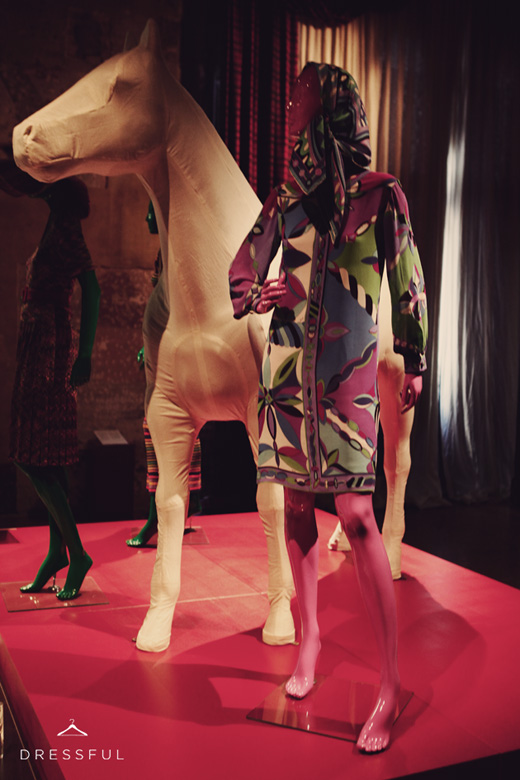
Emilio Pucci dress, 1968

Back in March I visited the Diana Vreeland After Diana Vreeland exhibition at Museo Fortuny in Venice, Italy. It was the day after the opening that was accompanied by an international symposium on Diana Vreeland, bringing to Venice notable scholars, curators and other fashion people I felt I should have recognized in the small, shaded streets surrounding the museum. When I saw a lady wearing a fabulous bright patchwork coat, I just knew she was not around by coincidence.

The exhibition, dedicated to Vreeland's life and work as fashion editor of Harper's Bazaar and editor-in-chief of Vogue, displays a selection of magazines and dresses by Yves Saint Laurent, Cristóbal Balenciaga, Emilio Pucci, Coco Chanel, Elsa Schiaparelli, Missoni and Ballets Russes costumes that Vreeland had collected. (Unfortunately they didn't let me take any more photos than the one above)

While I was tickled pink to share space with dresses by some of the best fashion designers of the 20th century at least for half an hour, the exhibition awoke a curiosity for Diana Vreeland's life beyond what you can read in encyclopedias and I longed for more biographical details. It mostly focuses on the philosophy and feeling of Vreeland: how she thought, how she worked, what she liked. Then again, fashion is never about revealing too much. Vreeland herself was the master of that.

The exhibition runs until June 25, 2012. Palazzo Fortuny, Venice, Italy.

Continue reading...

Venice window shopping

November 10, 2011

1 Comment

venice-jewelry

If you've ever been to Venice, you know the shopping is mostly about Venetian masks and Murano glass products (if you haven't been, the beautiful Elegance in Exile exhibition is more than enough reason to go). In the past year little second hand, vintage and consignment shops – from cheap to very expensive – have begun popping up at every corner, permeating the dense atmosphere of Tradition and making the city more in sync with those of us who keep returning to it yearning to be surprised by something new.

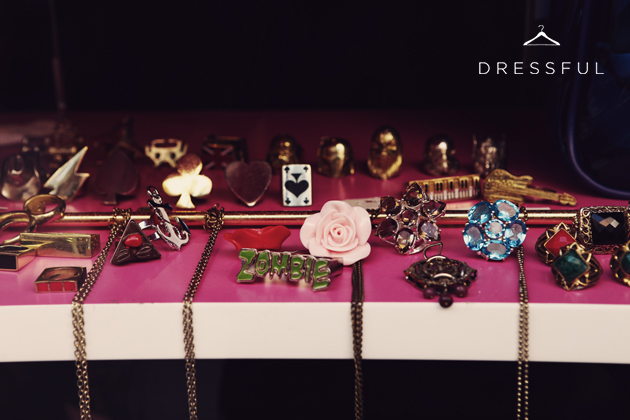
Though I rarely wear accessories other than bags, jewelry displays always catch my attention. I took this photo through the window because the shop was closed. It was just before Halloween, hence the zombie ring contributing to a most charming selection. It would be uncharacteristic for Venice, but I'd love if the shop was still there (and open) the next time I visit.

Continue reading...

Elegance in Exile exhibition: Russian expat fashion

October 31, 2011

11 Comments

Last weekend I took a quick trip to Venice with my family to see the Elegance in Exile: Between fashion and costume, the time of Sergei Diaghilev (L'eleganza in esilio. Tra moda e costume, il tempo di Diaghilev) exhibition at Palazzo Mocenigo.

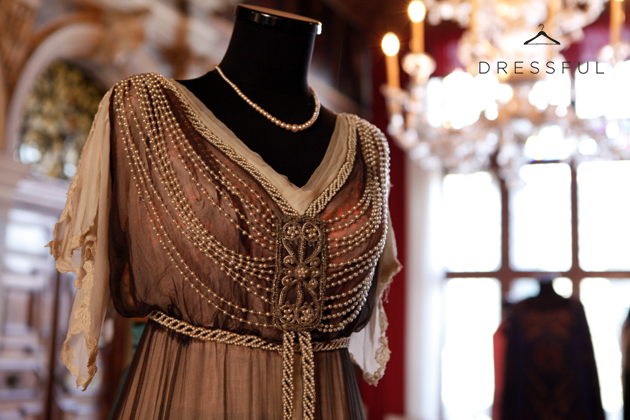
The exhibition portrays the influence of Russian émigrés on fashion, displaying costumes of Ballets Russes (The Russian Ballets) designed by Leon Bakst, Natalia Gončarova and Alexander Benois, as well as dresses worn by aristocrat Russian women who fled to Europe after the October Revolution in 1917. Most of the dresses are part of fashion historian Alexandre Vassiliev's personal collection, dating back to the 1920s and 1930s.

Elegance in exile exhibition

Elegance in exile exhibition

Elegance in exile exhibition

+++

We visit Venice approximately 4 times a year out of a fascination with its narrow street and magic atmosphere that only grows stronger with time. Thanks to my dad's internal GPS system we know our way around quite well, but we had never walked around the part of the city where the Palazzo Mocenigo is located before. Whenever you think you're almost there in Venice, you find out your destination is actually not where you thought it was, even if you followed the map closely. You have to go back a bit, cross another bridge, turn left and maybe you'll find it there … but not always.

Venice is alluring and deceiving. In her case, the second is a quality.

+++

Elegance in exile exhibitionCocktail dress
USA, circa 1926
Floral chiffon and velvet

+++

Elegance in exile exhibitionSecond to left: Evening dress
Worth Haute Couture house
Paris, 1922
Ivory satin with Russian folk style silver and gem embroidery

Evening cloak from Great Britain

+++

Elegance in exile exhibitionCocktail dress by Soeurs Carrott (that was written on the plate – could it be the Callot sisters?)
Paris, 1923
Red chiffon with Chinese style silk thread and bead embroidery

Cloak in art deco style
USA, 1925
Black brocade silk with floral pattern, metallic thread and fringes

Elegance in exile exhibitionEvening tunic by Anely
Istanbul, 1923
Black silk, embroidery with silver thread and red beads

Elegance in exile exhibitionEvening dress
London, 1919
Red lamé with bead trimming

+++

Elegance in exile exhibition

Left: Ballets Russes dark purple wool crêpe costume by Leon Bakst in 1923. Created for Ida Rubinstein in Phaedra by D'Annunzio and Racine.
Right: Ballets Russes costume in embroidered and hand-painted yellow ochre and fuchsia silk by Alexander Benois, created for the ballet The Nightingale (Le Rossignol). 1914.

The Russian Ballets, probably the greatest ballet company of the 20th century, took Paris (who had never seen anything like it before) by storm in 1908. They staged operas and ballets choreographed by Mikhail Fokine in the first season, but focused mainly on ballets later on.

Impresario Sergei Diaghilev was the driving force behind the Ballets. Because of his passion for art and ambition to work with the most talented costume designers, composers and dancers of his time, the Ballets became an international influence on fashion and culture. They introduced the oriental style, which went on to become a huge trend in Paris, and opulent, colorful costumes with Russian folkloric elements and fur embellishments, a far cry from Western fashion.

The famous Paris premiere of Stravinsky's Rite of Spring caused a riot in the audience partly because of the animalistic costumes by Nicholas Roerich. This scene was brilliantly recreated at the beginning of Jan Kounen's 2009 film Coco Chanel & Igor Stravinsky. In the same film Coco Chanel gives a custom-made rubashka blouse to Stravinsky's daughter. Chanel really did experiment with rubashkas and liked to use fur in dressmaking as many of her clients were Russian.

+++

Elegance in exile exhibitionEvening dress (back)
Belgrade, 1920
Magenta silk, bead embroidery

+++

Elegance in exile exhibition

Elegance in exile exhibition

Elegance in exile exhibition

+++

Elegance in exile exhibition

Elegance in exile exhibition

+++

Elegance in exile exhibitionDress by Lanvin
Paris, 1923
Silk with lamé brocade and lace trimming

+++

A note accompanying the exhibition tells me the Russian women who had fled the country lived in poverty and often had to find work as seamstresses or create embroideries in order to make a living. The exhibition, situated in a lavish Venetian palace, evokes images of impossibly glamorous world of aristo-expats lamenting their homeland in faraway cities, fancy dresses and evenings in opera houses being the only remnants of their glorious past. It is as if the exhibited dresses are competing in quality and quantity of beading and embroidery. They don't make such dresses any more, do they? The closest to them today would be haute couture, another world that will always stay alien to those not privileged enough to be a part of it, no matter how many documentaries on the subject they shoot and how many articles they write in attempt to uncover the mystery.

I particularly enjoyed seeing a dress by Charles Frederick Worth (considered to be the first couturier), though they had obstructed it with a giant unidentified cloak from Great Britain, and a lovely cobalt blue Lanvin number from 1923 – i.e. Lanvin by Jeanne Lanvin. The heaviness of the Russian Ballets costumes surprised me; they were probably difficult to dance in, especially as the dancers also wore large headgear (kolpak, ushanka).

Elegance in Exile makes a fashion history lover's heart flutter, offering a glimpse into the time when glamour was slower and more meticulous than we can afford today – figuratively and literally.


The exhibition is open until January 6 February 29, 2012.
Palazzo Mocenigo, Santa Croce 1992, Venice, Italy.

Continue reading...

Laura Biagiotti Spring/Summer 2012 show

September 26, 2011

2 Comments

laura-biagiotti-spring-summer-2012-04

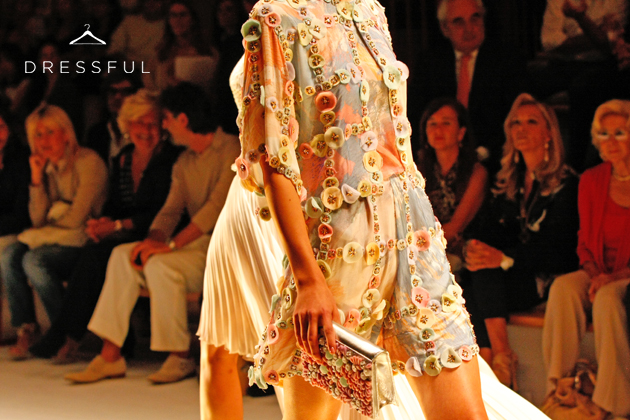
Laura Biagiotti's Spring/Summer 2012 collection is a romantic tribute to Venice, a city she adores. A luxurious harmony of colors, materials and decorations evokes the grandeur of Venice as an independent state, the "Most Serene Republic". Biagiotti translated the myth of the city to delicate lace dresses and lightweight knitwear in white, peach, lilac, pink and nude hues. Models strutted down the runway wearing shoes and accessories in gold, reflecting domes of St. Mark's Basilica. Beading and ornaments were reminiscent of colorful Venetian souvenirs made from Murano glass.

The collection was made for women attending decadent dinner parties in old palaces along Venice's Grand Canal. This is a fantasy of mine, I don't know if the parties still take place today, but I like to imagine exciting and extraordinary events going on in those stately buildings lit with crystal chandeliers.

laura-biagiotti-spring-summer-2012-08 laura-biagiotti-spring-summer-2012-07

This is not the first time Laura Biagiotti has explored the theme of Venice - the city inspired her iconic fragrance Venezia, released in 1992. Venezia, i.e. a modern orchestration of the original, was relaunched earlier this month after years of having been discontinued. Every guest received a 25 ml bottle of the fragrance after the show (I've never smelled the original Venezia so I can't compare them, but the new fragrance is so delicious I've decided to adopt it for the season).

I like how Biagiotti united different divisions of her brand in one event; it's impossible to say whether the perfume relaunch complements the collection or vice versa.

laura-biagiotti-spring-summer-2012-01

Another reason why this show meant a lot to me is that it was the first one where I had a seat. It was an amazing seat in the third row so close to the runway I was overcome with giddiness when I realized where I was sitting and couldn't stop smiling. I had a chance to absorb every detail, so it's far from surprising the collection left such a memorable impression. When Venice wakes up in spring, these are the clothes she's going to wear.

Continue reading...

Santa Maria Novella: Fragrances and stories

May 3, 2011

3 Comments

I. PROLOGUE
My family is crazy about fragrances, they're our souvenirs of sorts because when we travel, we always end up bringing home a new perfume, whether we planned it or not (you can barely get non-mainstream fragrance lines in Slovenia, even Hermès is tough call. Luckily Trieste and the wonderful Essenze shop that's bound to satisfy the finest of appetites are only an hour away by car).

Santa Maria Novella perfume box

Last weekend we were on a mission to find the Santa Maria Novella boutique near Palazzo Grassi in Venice. You can never be too sure you'll find what you're looking for in Venice because addresses and numbers don't mean or help much there, so such escapades are actually all about getting lost in shady little alleys and maybe finding something you like even better than what you were supposed to find ... It's very rewarding when the building suddenly materializes before you (or vice versa) after the long time you've spent walking, and clearly we were of luck that Sunday because at one point the Santa Maria Novella boutique appeared right in front of us.

II. (HI)STORY
Santa Maria Novella is one of the world's oldest pharmacies. It was established in Florence in 1612. Many of their products - ranging from candles and room sprays to fragrances and creams - are based on hundreds of years old recipes. Each bottle of SMN fragrances is numbered and upon purchase you get a certificate that you can fax to SMN Florence headquarters where they'll write your name down in their golden book (edit: mom corrected me this only applies if you buy Ottone or Porcellana, the two fragrances released for Santa Maria Novella's 400th anniversary). The golden book, the history, the package design and most of all, the smells themselves, it all has this luxurious old world charm I cannot be impervious to even though I myself live in the old world. My mom chose a cologne called Porcellana and has labeled me "perfume thief" in advance as I was very sincere and blatantly obvious about the fact that I plan to wear it too (I'm actually wearing it right now), breaking my longstanding self-imposed rule about never wearing the same fragrance as someone I see more or less every day (which has spared me from wearing many lovely scents, so maybe it's not that much of a good rule after all?) Porcellana is light and romantic, I usually go for more complex and unusual fragrances, yet this one works because it's simple, but not really.

Now that I think about it, most of all the fragrance evokes Florence, though my memory of it is sparse, so in my head Porcellana might be inventing a whole new world.

Santa Maria Novella perfume

Santa Maria Novella perfume

Santa Maria Novella perfume number

Continue reading...