Archive | Exhibitions RSS feed for this section

Joanne Stoker shoes at Vogue Talents Corner

March 14, 2012

4 Comments

On my unexpectedly free day during Milan fashion week, I popped into the Vogue Talents Corner at Palazzo Morando just off Via Monte Napoleone, one of Milan's most popular luxury shopping streets. Vogue Italia and thecorner.com have organized this exhibition for the second time to help emerging fashion designers from all over the globe gain international recognition. During the three days of the exhibition, you could also order pieces from the designers' Spring/Summer 2012 collections on the spot using Samsung tablets – one of the cleverest Fashion and Digital compounds I've seen.

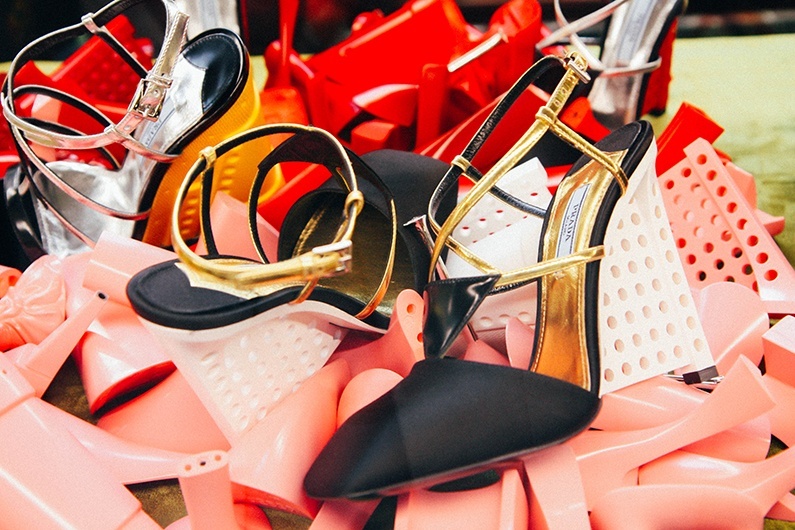
The 11 brands that participated in the exhibition were: AI_Andrea Incontri, Pedro Lourenço, Leitmotiv, Benedetta Bruzziches, C.B. Made in Italy, Mungo Gurney, Vernissage, Joanne Stoker, Shourouk, Hexa by Kuho and Ricostru. Of course, with a large number of designers comes an equally large number of (different) visions. The exhibition was too diverse to be summarized in a single post, so today I'd like to share just my favorite part of it: shoes by Joanne Stoker and AI_Andrea Incontri.

AI Andrea Incontri shoes
AI_ANDREA INCONTRI
The pink pump with silver specks is fairy tale material, almost too fragile to be worn. Then again, fashion never comes quite alive when put on display.

Joanne Stoker shoes

Joanne Stoker shoes

Joanne Stoker shoes

Joanne Stoker shoes

JOANNE STOKER
Because I see an abundance of beautiful clothes and accessories at fashion weeks, my friends often ask if it's difficult for me to constantly be exposed to covetable pieces, all of which I obviously cannot have. The truth is that the more I immerse myself in fashion, the less often I feel the desire to actually buy it. I think it's precisely because I see so much of it – as terribly ephemeral as it makes it all sound, if I skip something I like, there will most likely be a new, similar piece soon that I might like even more. With Joanne Stoker's shoes, however, I immediately knew I need not look any further: the first pair, perhaps in a slightly brighter colorway, might as well be my dream pair.

Continue reading...

Sens(n)ation Maison Martin Margiela exhibition

November 24, 2011

8 Comments

Sensnation Maison Martin Margiela

Sensnation Maison Martin Margiela Sensnation Maison Martin Margiela

This morning I had the honor to be among the first guests of the Sens(n)ation exhibition showcasing a historic overview of Maison Martin Margiela's first line (défilé) collection from 1989 to 2011 (23 looks), as well as garments and accessories by renowned Slovenian designers. The exhibition, a joint effort of multibrand designer store Wolfova 5 and Projekt27, is curated absolutely comme il faut; fashion-wise, this is the event that finally put Ljubljana on a global scale.

There's quite a Margiela cult in Slovenian fashion circles, making Sens(n)ation even more sens(n)ational. In a way – though if you asked people in the street who Margiela was, I don't think you'd get many sensible replies – this exhibition will cater to the widest of tastes. Fashion people will love it (or at least appreciate it as usually you'd have to go to another country to see an exhibition on this level), passers-by (i.e. the uninitiated into the Noble Art of Conceptual Fashion) will be provoked by what fashion can be – fashion that is not stripped to strict functionality, fashion beyond trends.

Sensnation Maison Martin Margiela Sensnation Maison Martin Margiela

Sensnation Maison Martin Margiela

I should note that the historic overview is actually very general public-friendly. There are no covered faces and other more or less bizarre facets that often alienate people from the complex world of Margiela; it's more about playing with sizes, materials, inspirations and humor. When you see the exhibition, I suggest you pick up the little booklet with details about each look so you won't miss out on Margiela's clever tricks.

Sensnation Maison Martin Margiela Sensnation Maison Martin Margiela

Sensnation Maison Martin Margiela Sensnation Maison Martin Margiela

1. Polka dot print dress, S/S 2006
2. Setup
3. Shirt with front made out of leather gloves, S/S 2001
4. Theater costume-inspired jacket, S/S 1993
5. Sleeveless "tailor dummy" jacket, S/S 1997
6. Setup
7. Size 78 coat and jeans, F/W 2000
8. Pink shouldered jacket, "destroyed" jeans, S/S 2008
9. Velvet dress, mohair cardigan, F/W 1995
10. Double-breasted sleeveless jacket, S/S 2004

+++

Regarding the second part of the exhibition, I cannot help but wonder how (Slovenian) designers feel about their work being displayed in the same space as Margiela's; it's an enormous challenge, yet the selection is careful enough that the Slovenian designers' part feels like a logical continuation of the Margiela part. Each designer has contributed two looks, the dominant color being black. Three accessories collections have been designed especially for Sens(n)ation: bags-sculptures by Marjeta Grošelj, jewelry by Srečko Molk and glass hats by Ana Lazovski.

Sensnation Jelena in Svetlana Proković Sensnation Sanija Reja

Sensnation Marjeta Grošelj Sensnation Dajana Ljubičić

1. Dress by JSP Jelena and Svetlana Proković
2. Dresses by Sanija Reja
3. Bag by Marjeta Grošelj
4. Sweater and dress by Dajana Ljubičić

Most of the designers are part of the younger generation; I miss humor in their otherwise beautiful, well-constructed garments, the same humor Margiela has in his little finger. On the other hand, I understand that creative insouciance can only be achieved after you have fallen and risen again a thousand times. A quality of the masters.

The exhibition will be open from November 25 to December 4. Free admission.
Galerija Jakopič, Slovenska 9, Ljubljana.

Continue reading...

Elegance in Exile exhibition: Russian expat fashion

October 31, 2011

9 Comments

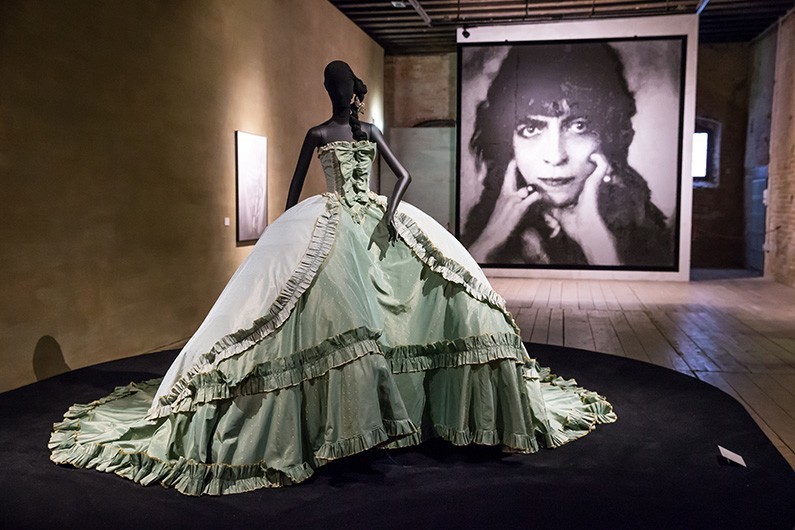
Last weekend I took a quick trip to Venice with my family to see the Elegance in Exile: Between fashion and costume, the time of Sergei Diaghilev (L'eleganza in esilio. Tra moda e costume, il tempo di Diaghilev) exhibition at Palazzo Mocenigo.

The exhibition portrays the influence of Russian émigrés on fashion, displaying costumes of Ballets Russes (The Russian Ballets) designed by Leon Bakst, Natalia Gončarova and Alexander Benois, as well as dresses worn by aristocrat Russian women who fled to Europe after the October Revolution in 1917. Most of the dresses are part of fashion historian Alexandre Vassiliev's personal collection, dating back to the 1920s and 1930s.

Elegance in exile exhibition

Elegance in exile exhibition

Elegance in exile exhibition

+++

We visit Venice approximately 4 times a year out of a fascination with its narrow street and magic atmosphere that only grows stronger with time. Thanks to my dad's internal GPS system we know our way around quite well, but we had never walked around the part of the city where the Palazzo Mocenigo is located before. Whenever you think you're almost there in Venice, you find out your destination is actually not where you thought it was, even if you followed the map closely. You have to go back a bit, cross another bridge, turn left and maybe you'll find it there … but not always.

Venice is alluring and deceiving. In her case, the second is a quality.

+++

Elegance in exile exhibitionCocktail dress
USA, circa 1926
Floral chiffon and velvet

+++

Elegance in exile exhibitionSecond to left: Evening dress
Worth Haute Couture house
Paris, 1922
Ivory satin with Russian folk style silver and gem embroidery

Evening cloak from Great Britain

+++

Elegance in exile exhibitionCocktail dress by Soeurs Carrott (that was written on the plate – could it be the Callot sisters?)
Paris, 1923
Red chiffon with Chinese style silk thread and bead embroidery

Cloak in art deco style
USA, 1925
Black brocade silk with floral pattern, metallic thread and fringes

Elegance in exile exhibitionEvening tunic by Anely
Istanbul, 1923
Black silk, embroidery with silver thread and red beads

Elegance in exile exhibitionEvening dress
London, 1919
Red lamé with bead trimming

+++

Elegance in exile exhibition

Left: Ballets Russes dark purple wool crêpe costume by Leon Bakst in 1923. Created for Ida Rubinstein in Phaedra by D'Annunzio and Racine.
Right: Ballets Russes costume in embroidered and hand-painted yellow ochre and fuchsia silk by Alexander Benois, created for the ballet The Nightingale (Le Rossignol). 1914.

The Russian Ballets, probably the greatest ballet company of the 20th century, took Paris (who had never seen anything like it before) by storm in 1908. They staged operas and ballets choreographed by Mikhail Fokine in the first season, but focused mainly on ballets later on.

Impresario Sergei Diaghilev was the driving force behind the Ballets. Because of his passion for art and ambition to work with the most talented costume designers, composers and dancers of his time, the Ballets became an international influence on fashion and culture. They introduced the oriental style, which went on to become a huge trend in Paris, and opulent, colorful costumes with Russian folkloric elements and fur embellishments, a far cry from Western fashion.

The famous Paris premiere of Stravinsky's Rite of Spring caused a riot in the audience partly because of the animalistic costumes by Nicholas Roerich. This scene was brilliantly recreated at the beginning of Jan Kounen's 2009 film Coco Chanel & Igor Stravinsky. In the same film Coco Chanel gives a custom-made rubashka blouse to Stravinsky's daughter. Chanel really did experiment with rubashkas and liked to use fur in dressmaking as many of her clients were Russian.

+++

Elegance in exile exhibitionEvening dress (back)
Belgrade, 1920
Magenta silk, bead embroidery

+++

Elegance in exile exhibition

Elegance in exile exhibition

Elegance in exile exhibition

+++

Elegance in exile exhibition

Elegance in exile exhibition

+++

Elegance in exile exhibitionDress by Lanvin
Paris, 1923
Silk with lamé brocade and lace trimming

+++

A note accompanying the exhibition tells me the Russian women who had fled the country lived in poverty and often had to find work as seamstresses or create embroideries in order to make a living. The exhibition, situated in a lavish Venetian palace, evokes images of impossibly glamorous world of aristo-expats lamenting their homeland in faraway cities, fancy dresses and evenings in opera houses being the only remnants of their glorious past. It is as if the exhibited dresses are competing in quality and quantity of beading and embroidery. They don't make such dresses any more, do they? The closest to them today would be haute couture, another world that will always stay alien to those not privileged enough to be a part of it, no matter how many documentaries on the subject they shoot and how many articles they write in attempt to uncover the mystery.

I particularly enjoyed seeing a dress by Charles Frederick Worth (considered to be the first couturier), though they had obstructed it with a giant unidentified cloak from Great Britain, and a lovely cobalt blue Lanvin number from 1923 – i.e. Lanvin by Jeanne Lanvin. The heaviness of the Russian Ballets costumes surprised me; they were probably difficult to dance in, especially as the dancers also wore large headgear (kolpak, ushanka).

Elegance in Exile makes a fashion history lover's heart flutter, offering a glimpse into the time when glamour was slower and more meticulous than we can afford today – figuratively and literally.


The exhibition is open until January 6 February 29, 2012.
Palazzo Mocenigo, Santa Croce 1992, Venice, Italy.

Continue reading...