Tag Archives: vogue

Diana Vreeland: The Eye Has to Travel documentary

September 23, 2012

5 Comments

As soon as I managed to restrain one bad welcome-to-London cold (my initial response to the city's winds and draughts), I popped over to Mayfair to see the Diana Vreeland: The Eye Has to Travel documentary. Enough of her former protégés and colleagues are still alive to continue dispersing the myth and legend of Diana Vreeland, but because the issues of Harper's Bazaar and Vogue that she edited are now stacked away in museum archives and publicly known facts on her personal life are sparse, I never felt like I understood the extent of Vreeland's influence on fashion – earth-shattering influence, as they would all say. Instead of more talking, I hoped this documentary would convince me by showing why Vreeland was the greatest fashion editor of all time.

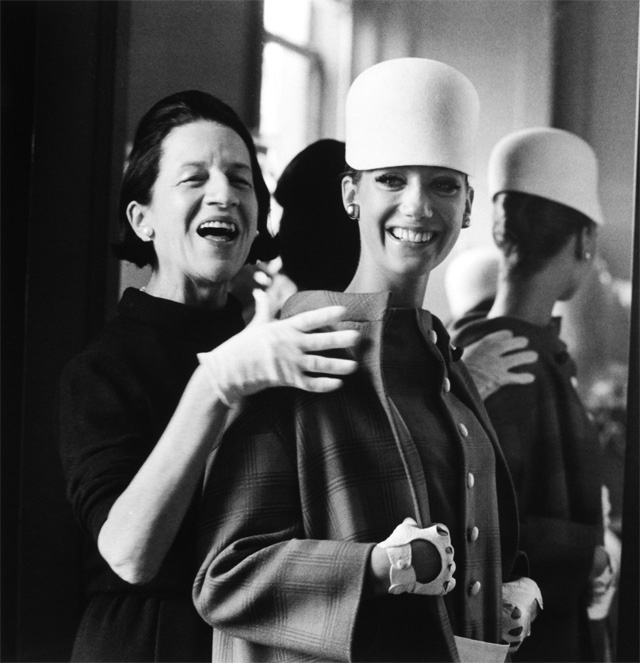
Diana Vreeland with model Marisa Berenson. Photo by James Karales

The Eye Has to Travel is a montage of Diana Vreeland's interviews that she gave later in life, archive footage of Paris, London and New York (where she lived), Harper's Bazaar spreads and recollections by her friends and family, among them Richard Avedon, Anjelica Huston, Oscar de la Renta and her sons. As any fictional work would, the film omits parts of Vreeland's life such as her marriage and children, which she was not keen to discuss; she mentions briefly in an interview that she was so engaged with her work there wasn't room for anything else. The documentary portraits Vreeland as more extraordinary, more dedicated, more innovative, more eccentric, more energetic than anyone working in fashion today (we only read about the ice queens, anyway). Just when you're ready to proclaim its cheesiness, you realize Vreeland actually was larger than life for one reason: she had history by her side. She lived and thrived in times that embraced changes and inspired cultural shifts, e.g. the Roaring Twenties (which she spent dancing in Paris) and the Sixties in London; the only way to go was forward, and her penchant for exaggeration took her work even further ahead of others. It also helped that she appeared to have an unlimited budget for stories; it was only natural to send Richard Avedon to Egypt to shoot Dovima for two weeks or visit countless sumo matches in Japan to find a wrestler taller than Veruschka.

It so happened that I got an answer to an already forgotten question at the theater. Visiting the Diana Vreeland After Diana Vreeland exhibition in May, I was drawn to a white horse sculpture in the middle of the room. I had no idea whether there was a story behind it or the curator had only put it there to look cool, but when the security guard told me I could only take one photo, I knew the horse had to be in it. In the film Vreeland explained that racehorses were her idea of great style because of their majesty. She used the same white horse sculptures in the exhibitions she curated at the Metropolitan Museum of Art.

I didn't see all of Diana Vreeland's life in those 84 minutes, but it may have been the closest I'll ever get to an understanding of her. When I left the theater, I felt inspired after months of sporadic writing and fruitless contemplation. Inspiration is a word people throw around too lightly in fashion. I'm not inspired by a stream of unrelated photos on Tumblr. I'm only inspired by people, their zest for life, their achievements or kindness … And when I'm inspired, I up my game. In this respect, The Eye Has to Travel has been a much better welcome to London than a runny nose and pestering cough.

Continue reading...

Diana Vreeland After Diana Vreeland exhibition

May 23, 2012

5 Comments

Diana Vreeland After Diana Vreeland
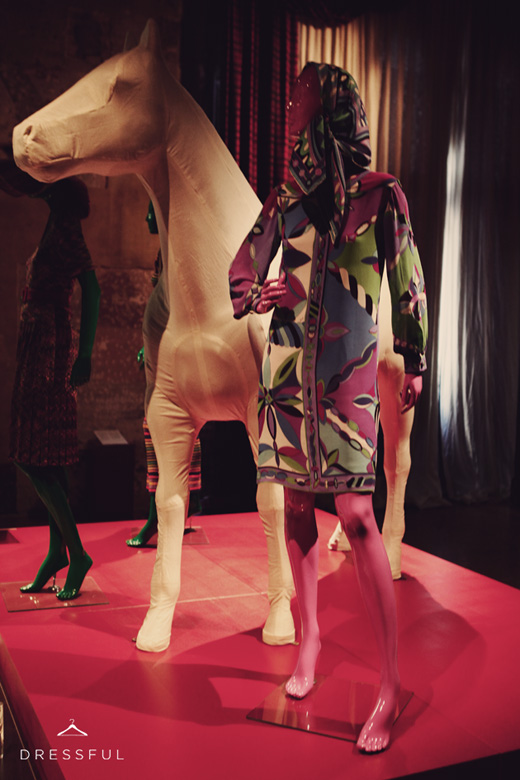
Emilio Pucci dress, 1968

Back in March I visited the Diana Vreeland After Diana Vreeland exhibition at Museo Fortuny in Venice, Italy. It was the day after the opening that was accompanied by an international symposium on Diana Vreeland, bringing to Venice notable scholars, curators and other fashion people I felt I should have recognized in the small, shaded streets surrounding the museum. When I saw a lady wearing a fabulous bright patchwork coat, I just knew she was not around by coincidence.

The exhibition, dedicated to Vreeland's life and work as fashion editor of Harper's Bazaar and editor-in-chief of Vogue, displays a selection of magazines and dresses by Yves Saint Laurent, Cristóbal Balenciaga, Emilio Pucci, Coco Chanel, Elsa Schiaparelli, Missoni and Ballets Russes costumes that Vreeland had collected. (Unfortunately they didn't let me take any more photos than the one above)

While I was tickled pink to share space with dresses by some of the best fashion designers of the 20th century at least for half an hour, the exhibition awoke a curiosity for Diana Vreeland's life beyond what you can read in encyclopedias and I longed for more biographical details. It mostly focuses on the philosophy and feeling of Vreeland: how she thought, how she worked, what she liked. Then again, fashion is never about revealing too much. Vreeland herself was the master of that.

The exhibition runs until June 25, 2012. Palazzo Fortuny, Venice, Italy.

Continue reading...

Joanne Stoker shoes at Vogue Talents Corner

March 14, 2012

4 Comments

On my unexpectedly free day during Milan fashion week, I popped into the Vogue Talents Corner at Palazzo Morando just off Via Monte Napoleone, one of Milan's most popular luxury shopping streets. Vogue Italia and thecorner.com have organized this exhibition for the second time to help emerging fashion designers from all over the globe gain international recognition. During the three days of the exhibition, you could also order pieces from the designers' Spring/Summer 2012 collections on the spot using Samsung tablets – one of the cleverest Fashion and Digital compounds I've seen.

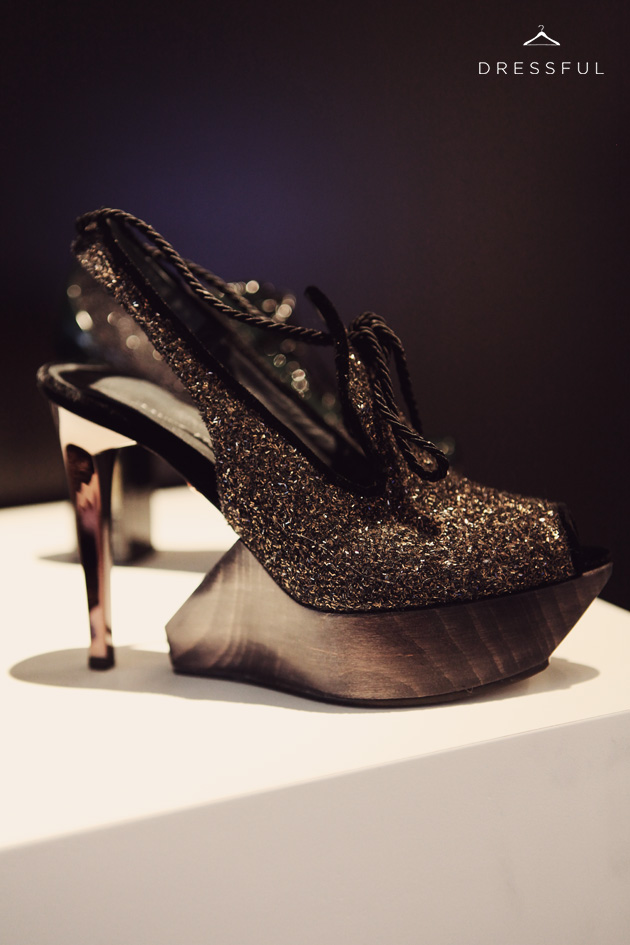
The 11 brands that participated in the exhibition were: AI_Andrea Incontri, Pedro Lourenço, Leitmotiv, Benedetta Bruzziches, C.B. Made in Italy, Mungo Gurney, Vernissage, Joanne Stoker, Shourouk, Hexa by Kuho and Ricostru. Of course, with a large number of designers comes an equally large number of (different) visions. The exhibition was too diverse to be summarized in a single post, so today I'd like to share just my favorite part of it: shoes by Joanne Stoker and AI_Andrea Incontri.

AI Andrea Incontri shoes
AI_ANDREA INCONTRI
The pink pump with silver specks is fairy tale material, almost too fragile to be worn. Then again, fashion never comes quite alive when put on display.

Joanne Stoker shoes

Joanne Stoker shoes

Joanne Stoker shoes

Joanne Stoker shoes

JOANNE STOKER
Because I see an abundance of beautiful clothes and accessories at fashion weeks, my friends often ask if it's difficult for me to constantly be exposed to covetable pieces, all of which I obviously cannot have. The truth is that the more I immerse myself in fashion, the less often I feel the desire to actually buy it. I think it's precisely because I see so much of it – as terribly ephemeral as it makes it all sound, if I skip something I like, there will most likely be a new, similar piece soon that I might like even more. With Joanne Stoker's shoes, however, I immediately knew I need not look any further: the first pair, perhaps in a slightly brighter colorway, might as well be my dream pair.

Continue reading...

Hats off to summer!

July 11, 2011

3 Comments

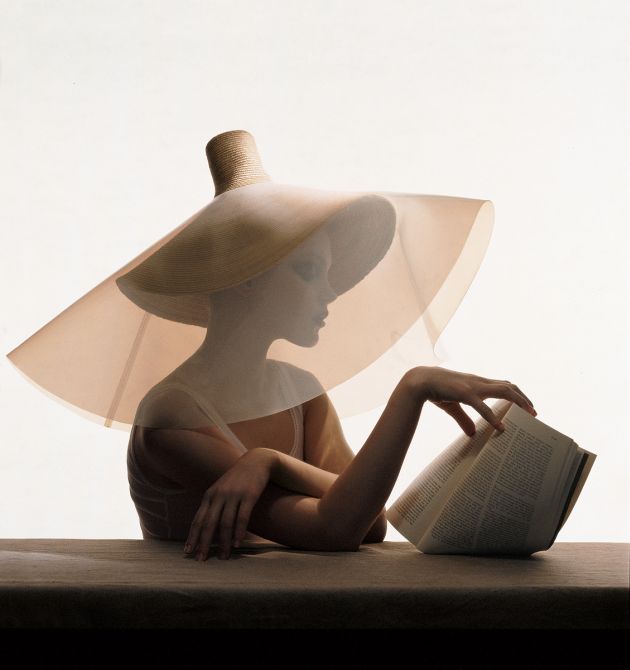
Yohji Yamamoto straw hat with clear plastic overlay

Yohji Yamamoto straw hat with clear plastic overlay | Photo by Irving Penn, 2004

The season of spending my time between Ljubljana and seaside has opened. It is so soothing to get away from Ljubljana sometimes, the Ljubljana of too strong perfumes, unsanitary obsession with money, connections and brands, faux intellectuals and uncultured parvenus from towns and villages so small you won't find them on the map*; they waste their lives trying to impress other similarly depthless individuals with money, connections and brands, though they don't even like those people. Mix a little fever with my post-teenage angst and you'll find me confiding in my moleskine how, once you get back to Ljubljana, all your problems you didn't think about while you were away crush upon you in an instant again.

Heat is the only thing Ljubljana and seaside have in common in summer, and in heat what a girl needs is a good dress and a good hat. I have a glamorous black hat reminiscent of Sofia Loren and Brigitte Bardot on the French riviera in the 1960s, which means it's a sacred object and stays in the closet all the time, unworn and almost untouched. When I bought it, I promised myself I'd wear it to the French riviera one day, but before that? It would have to be a truly special occasion. My dresses? Too precious to be exposed to direct sunlight (not to mention sweat marks, the least desirable accessory), except when I'm feeling extravagant and I just go out dressed all in black at noon. This is not rare, so unlike the hat, my dresses do get some summer lovin'. Otherwise I'm promenading around in Zara shorts (one button missing) and tank tops. I am the very definition of fashion.

The one hat I would absolutely wear right now (despite its preciousness "must-not-touch!"** factor) is the Yohji Yamamoto straw hat with plastic overlay, pictured above. I love how it protects not only your head (so your thoughts don't boil), but also your shoulders, the greatest indicator of whether you've been prim and proper and stayed indoors from 11 to 5 every sunny day. For the first time in years I am going to cheat on my aristocratic pallor by sunbathing just a little to cover swimsuit-induced tan lines. Fate has brought me a new floral dress with completely open back; at 21, you don't let such an opportunity go, you own it.

* In fear of being taken wrong on my own fashion blog, I must immediately note that being cultured has nothing to do with where you come from; I just find it fascinating how the aforementioned uncultured, once they've become Ljubljanites and therefore "en vogue", will never mention their origins again ...

** Why do I get so intimidated by inanimate objects is the real question here

Continue reading...

Vogue India racism: Only light skin is beautiful!

February 7, 2011

48 Comments

I've recently ordered an issue of Vogue India on eBay to subject it to my most thorough analysis. As Indian culture is completely different from the European culture I'm used to, I wanted to see if that translates into a different Vogue too.

I was particularly interested in whether Vogue India - like the Western media - also promotes an extremely narrow standard of female beauty.

+++

My most shocking discovery wasn't that Vogue India is absolutely guilty of the above crime. It was that many Indian people (mostly women) are so obsessed with fair skin they'll go to the ends of the Earth to lighten theirs. They believe dark skin is ugly and light skin guarantees more opportunities in life. For example, "in newspaper advertisements through which brides and bridegrooms are sought, fair skin is ranked as a more desirable attribute than a university degree" (source).

Vogue India fully endorses this mania by featuring exclusively light-skinned models and celebrities. Even some of the more "regular" people in society pages could pass off as Hispanic or Latino!

The magazine also advertises several skin-lightening creams:

L'Oreal skin-lightening cream, Vogue IndiaL'Oreal skin-lightening cream, Vogue India

Garnier skin-lightening cream, Vogue IndiaGarnier skin-lightening cream, Vogue India

Neutrogena skin-lightening cream, Vogue India

Quick background on skin color issues in India: Indian people from North India generally have lighter skin than those from South India because of different climates. The point is that the average Indian person is not as light-skinned as models, celebrities and Bollywood actresses. Many sources claim that the fascination with lighter skin stems from India's caste system. People from the higher classes were lighter and those from the lower classes were darker because they did a lot of manual labor under the sun. So lighter skin was associated with wealth and power.

The same mindset carried on after India had been colonized by Britain. Again, the ruling class was light-skinned. Many say the situation in India is much the same today, even with the British gone and the caste system officially abolished.

+++

My opinion about using skin-lightening products is mixed. On one hand, I believe everyone is free to do whatever they want as long as they're not hurting anyone else. I therefore support fairness creams. If they produce good results that make people happy, that's amazing. However, it's sad the opinion that only fair skin is beautiful is so deeply ingrained into the culture. This means skin lightening is often not what Indian people do for themselves. They're pressured into it by society.

Foreign cosmetic brands' fairness creams have only a small market share in India (source). The most popular is a domestic brand called Fair and Lovely, notorious for this advertisement:

The advert was known as "the air hostess ad".
It showed a young, dark-skinned girl's father lamenting he had no son to provide for him, as his daughter's salary was not high enough - the suggestion being that she could neither get a better job or get married because of her dark skin.

The girl then uses the cream, becomes fairer, and gets a better-paid job as an air hostess - and makes her father happy. (source)

Way to convince people skin color is only relevant when it comes to judging beauty!

+++

It bothers me that only light skin and an almost European look are good enough for Vogue (India). It bothers me to see magazines suggesting people have to change something about their physical appearance or personality. Vogue especially is supposed to be about beauty and art - which are never uniform - but it's all theory instead of practice.

+++

Vogue India cover by Tanya Bipasha Ling

Vogue India cover illustration by Tanya Bipasha Ling

Vogue India likes thinness, too. Former Miss Universe gone famous actress (who looks white) complains in an interview that she needs to lose 6 pounds to fit into body-con dresses. Pages later, a celebrity cookbook author (who looks slightly tanned) shares her tips on how to lose weight. They're disguised as nice, telling you to indulge in "guilty pleasures" every once in a while, but it's a diet. Plain and simple.

Do people think they should lose weight before stumbling upon dieting tips in a magazine or after?

+++

Vogue India is a licensed magazine, so the fact that it prominently features some of the more disturbing Western obsessions can definitely be attributed to that. Condé Nast has a say in the content of every Vogue edition and there's a whole lot of money in first showing you dream skin, dream weight, dream closet, dream spouse, dream lifestyle and then advertising whatever is supposed to help you achieve these things (but it really won't).

Not everything I've mentioned in this very "J'accuse" post is Vogue India's fault. Still, I feel incredibly disappointed that insane "beauty ideals" enforced by either the media or culture aren't going away but rather becoming omnipresent.

If you liked this post, please share it on Facebook or Twitter. Thank you!

Continue reading...